
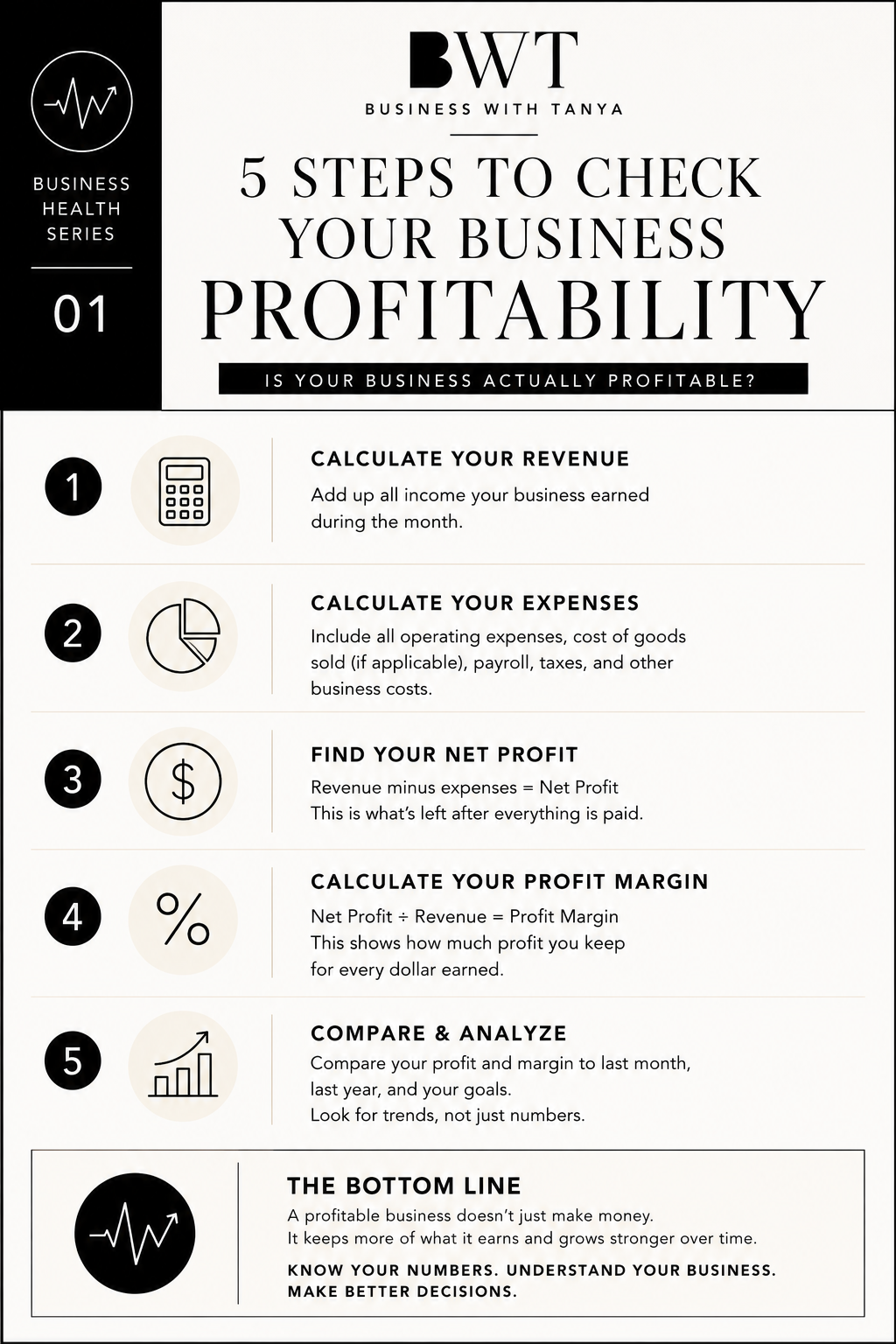
Is Your Business Actually Profitable? Business Health Series | Part 1
Your business is making sales. Money is coming into the bank account. Customers are paying. Revenue may even be higher than it was last year.
But does that mean your business is actually profitable?
Not necessarily.
One of the most important things a business owner can understand is the difference between bringing in money and actually making money. A business can generate strong revenue and still struggle financially if expenses are consuming too much of what comes in.
Profitability gives you a clearer picture of whether the business is financially working—not just whether it is busy.
The Direct Answer: How Do You Know If Your Business Is Profitable?
At its simplest:
Revenue – Expenses = Profit
Revenue is the money your business earns.
Expenses are the costs required to operate the business.
Profit is what remains after those expenses are accounted for.
For example:
Revenue: $25,000
Expenses: $20,000
Profit: $5,000
That business generated $25,000 in revenue, but it did not make $25,000. Its profit was $5,000.
Understanding that difference is one of the foundations of financial clarity.
1. Start With Your Revenue
First, know how much money the business is actually generating.
Look at revenue by month, quarter, and year rather than relying on what you remember selling or what is currently sitting in your bank account.
Ask:
Is revenue increasing?
Is it consistent?
Are certain products or services responsible for most of it?
Are there predictable slow periods?
Revenue is an important number, but it is only the beginning of the story.
2. Know What It Costs to Run the Business
Next, look at where the money is going.
Depending on the business, expenses might include:
Payroll
Contractors
Rent
Software
Marketing
Insurance
Supplies
Professional services
Equipment
Merchant or payment processing fees
Small expenses can also add up quickly.
If revenue increases while expenses increase even faster, the business can become busier without becoming more profitable.
3. Look at What Is Actually Left
Once you understand revenue and expenses, look at the amount remaining.
That is where profitability starts becoming clearer.
Imagine two businesses each generate $500,000 in annual revenue.
Business A
Revenue: $500,000
Expenses: $475,000
Profit: $25,000
Business B
Revenue: $500,000
Expenses: $350,000
Profit: $150,000
They have identical revenue.
They have very different businesses financially.
This is why comparing businesses based only on sales can be misleading.
4. Don't Confuse Your Bank Balance With Profit
One of the easiest mistakes to make is looking at the business bank account and assuming the balance represents profit.
It doesn't.
Money in the account may already be needed for:
Payroll
Taxes
Upcoming bills
Vendor payments
Debt payments
Future operating expenses
Your bank balance tells you how much cash is available at a particular moment.
Your financial reports help tell you how the business is actually performing.
You need both pieces of information.
5. Track Profitability Over Time
Knowing whether you were profitable last month is helpful.
Knowing the trend is much more valuable.
Review your financial results consistently and compare them over time.
You might discover:
Revenue is increasing but profit is shrinking.
One service generates significant revenue but very little profit.
Expenses have slowly increased.
A price increase improved margins.
A busy season isn't as profitable as you assumed.
The business performs better during certain months.
Those patterns can help you make better decisions before small problems become bigger ones.
What Does This Look Like in Real Life?
Imagine a business owner has her best month ever.
The business generates $40,000 in revenue.
She's excited—and she should be.
But then she reviews the numbers.
Payroll and contractors: $15,000
Operating expenses: $9,000
Marketing: $4,000
Software and other expenses: $3,000
That leaves approximately $9,000 before considering other obligations that may apply to the business.
Suddenly, the $40,000 month looks different.
It wasn't a bad month. In fact, it may have been a very good one.
But the revenue number alone didn't tell the full story.
That is the value of understanding profitability.
Why Profitability Matters as Your Business Grows
Profit gives a business options.
A consistently profitable business may be better positioned to:
Build cash reserves
Hire employees
Invest in equipment
Increase marketing
Pay down debt
Prepare for taxes
Handle slower months
Invest in future growth
Growth without profitability can create pressure instead of freedom.
The goal isn't simply to build a business that generates more money.
It's to build a business that keeps enough of what it earns to support the owner, the team, and the future of the company.
The CEO Takeaway
Revenue tells you how much your business generates. Profit helps tell you how well the business is actually performing.
Don't measure the health of your company by sales alone.
Know what's coming in.
Know what's going out.
Know what's left.
Because once you understand those numbers, you can start making decisions based on what your business is actually telling you—not assumptions.
Continue the Business Health Series
Next: Why More Revenue Doesn't Always Mean More Money
In Part 2 of the Business Health Series, we'll look at why growing revenue doesn't automatically create more cash or more profit—and what business owners should watch as sales increase.
