
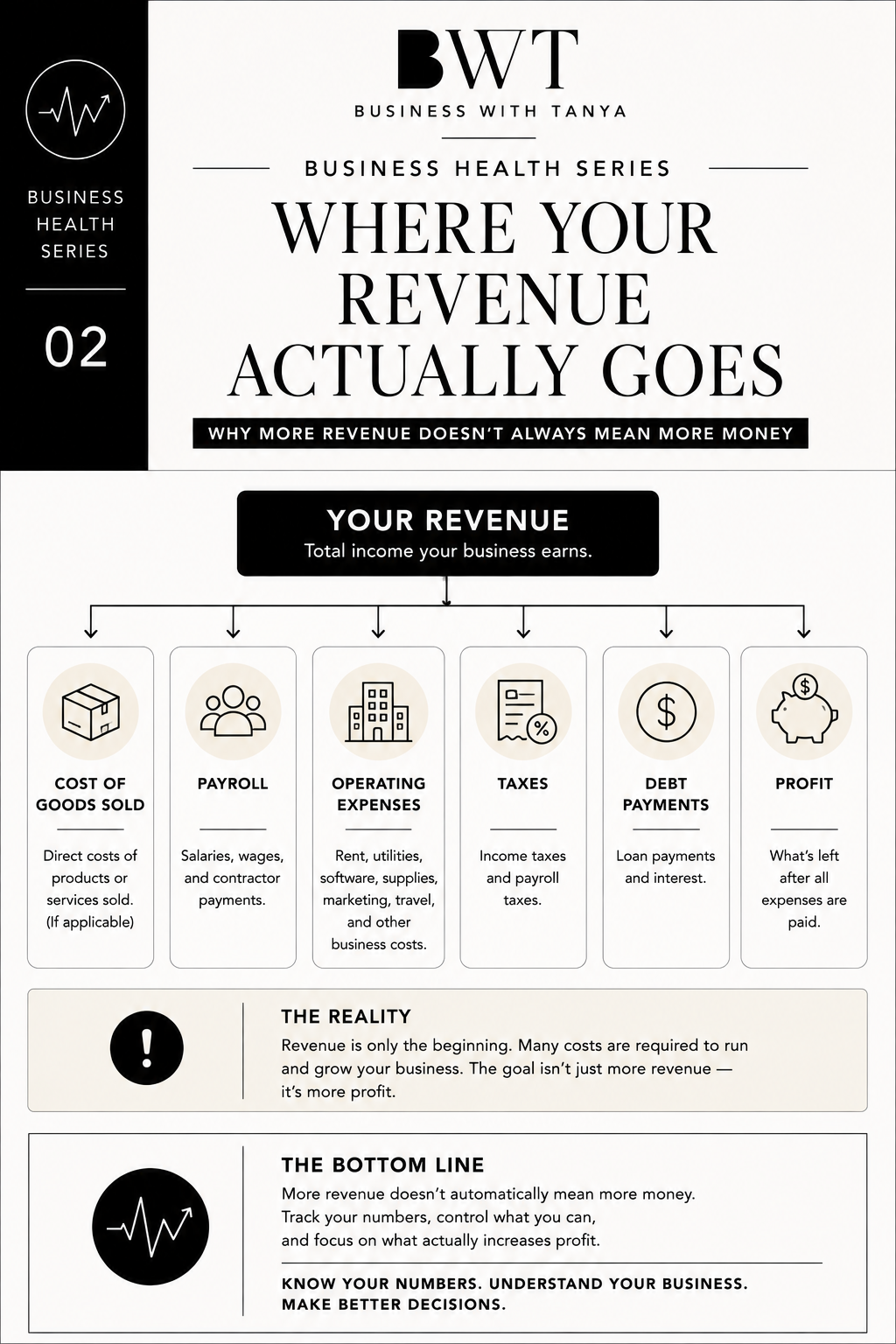
Why More Revenue Doesn't Always Mean More Money Business Health Series | Part 2
More sales usually feel like a sign that your business is moving in the right direction.
You land more clients. Orders increase. Your monthly revenue hits a new high.
But then you look at the bank account and wonder:
Where did all the money go?
Growing revenue is important, but revenue alone doesn't tell you whether your business is becoming financially stronger.
A business can make more money than ever before and still have less cash available, lower profit, or more financial pressure.
The Direct Answer: Why Doesn't More Revenue Always Mean More Money?
Because revenue is what your business brings in—not what your business keeps.
As revenue grows, the costs required to generate that revenue may grow too.
You might need:
More employees or contractors
More inventory or supplies
Additional software
More advertising
Larger facilities
New equipment
Increased professional support
If those expenses grow as fast as—or faster than—your revenue, your sales can increase without creating much additional profit.
That's why healthy growth requires looking beyond the top-line revenue number.
1. Compare Revenue Growth With Expense Growth
When revenue increases, one of the first things to check is whether expenses are increasing too.
Imagine your business goes from:
$50,000 in monthly revenue
to
$65,000 in monthly revenue
That's a $15,000 increase.
Great.
But what if generating that additional revenue required:
$7,000 in additional payroll
$3,000 in advertising
$2,000 in contractors
$1,500 in software and other expenses
Suddenly, that extra $15,000 in revenue doesn't look like an extra $15,000 in your pocket.
The question isn't simply:
“Did our revenue grow?”
It's:
“What did it cost us to create that growth?”
2. Pay Attention to Your Margins
Margins help you understand how much of your revenue remains after certain costs.
This becomes especially important as your business grows.
You could sell more while making less on each sale.
For example, you might:
Discount too heavily to attract customers
Pay more for labor
Experience higher supply costs
Add services that require more resources
Underprice a popular offer
Revenue might continue climbing while profitability slowly gets weaker.
That's why the quality of your revenue matters—not just the amount.
3. Understand the Cost of Growth
Growth usually requires investment.
That isn't necessarily a bad thing.
You may need to spend money today to build a stronger company tomorrow.
The problem comes when business owners increase spending without understanding whether those investments are actually producing results.
Before adding a major expense, ask:
What is this supposed to improve?
How much will it cost?
What financial result are we expecting?
How will we measure whether it worked?
Can the business comfortably support the expense?
Growth should be intentional—not simply expensive.
4. Don't Confuse Profit With Cash Flow
Profit and cash flow are connected, but they aren't the same thing.
Your financial reports might show that the business had a profitable month while your bank account still feels tight.
Why?
Timing matters.
You may have:
Customers who haven't paid yet
Large bills due this month
Debt payments
Tax payments
Equipment purchases
Inventory purchases
Other cash obligations
That's why a growing business needs to watch both profitability and cash flow.
Profit helps you understand financial performance.
Cash flow helps you understand how money is actually moving through the business.
You need visibility into both.
5. Measure What the Business Actually Keeps
Revenue is exciting because it's easy to see.
But the bigger question is:
What is the business keeping after the costs required to generate that revenue?
Instead of only celebrating:
“We hit $100,000 in revenue!”
also ask:
How profitable was that $100,000?
How much cash did the business generate?
Did our margins improve?
Did the business become financially stronger?
Those questions give you a much clearer picture of whether growth is actually working.
What Does This Look Like in Real Life?
Imagine a business generates:
Year 1 Revenue: $400,000
Then grows to:
Year 2 Revenue: $550,000
That's an additional $150,000 in revenue.
From the outside, the business looks significantly more successful.
But during that growth, the company added employees, increased marketing, purchased new software, and took on additional operating expenses.
If expenses increased by $140,000, the business only created $10,000 in additional profit from that $150,000 increase in revenue.
The company grew.
But financially, it didn't improve nearly as much as the revenue number suggests.
That's the difference between getting bigger and getting financially stronger.
Why This Matters for Business Owners
Revenue is important.
You need sales to build a sustainable business.
But chasing revenue without understanding profit, margins, expenses, and cash flow can create a business that looks successful from the outside while feeling financially stressful behind the scenes.
Healthy growth should eventually give your business more:
Financial stability
Cash reserves
Profit
Capacity
Flexibility
Opportunity
Not simply more work.
The CEO Takeaway
More revenue doesn't automatically mean more money.
As your business grows, don't only ask:
“How much did we sell?”
Ask:
“What did it cost us to generate those sales—and what did we actually keep?”
The goal isn't simply to build a bigger business.
It's to build a healthier, stronger, and more sustainable one.
Continue the Business Health Series
Next: 5 Signs Your Business Is Financially Healthy
In Part 3 of the Business Health Series, we'll look at five signs that can help you determine whether your business is actually on solid financial ground.
