
The Difference Between Revenue, Profit, and Cash Flow
Your business brought in $100,000.
Is that good?
It sounds good. But that number alone doesn't tell you whether the business is actually financially healthy.
How much did it cost to generate that revenue?
How much profit did the business keep?
And most importantly, how much cash is actually available?
Revenue, profit, and cash flow are three different numbers — and understanding the difference between them is essential for understanding the financial health of your business.
Revenue, Profit, and Cash Flow Are Not the Same Thing
Business owners often use these terms interchangeably.
But each one tells you something different.
Revenue tells you how much money the business earned from sales before expenses.
Profit tells you what's left after expenses are deducted.
Cash flow tells you how money is actually moving into and out of the business.
Looking at only one of these numbers can give you an incomplete picture.
Looking at all three together gives you much better financial clarity.
Here's what every business owner should understand.
1. Track Your Total Revenue
Revenue is the money your business generates from selling its products or services before expenses are deducted.
For example, if your business sells $50,000 worth of services during the month, your revenue is $50,000.
Revenue can help you measure:
Sales activity
Business growth
Customer demand
Performance over time
Progress toward sales goals
Growing revenue is usually a positive sign.
But there's an important distinction:
Revenue is not the amount of money you made personally, and it isn't automatically profit.
A business can generate significant revenue while spending nearly all of it.
That's why revenue should never be viewed by itself.
2. Understand Your Expenses
To understand whether your revenue is actually creating financial progress, you need to know what it costs to run the business.
Expenses might include:
Payroll
Rent
Software
Insurance
Marketing
Contractors
Supplies
Equipment
Professional services
Utilities
Other operating costs
Imagine two businesses each generate $100,000 in revenue.
Business A spends $60,000 operating the business.
Business B spends $95,000.
Their revenue is identical.
Their financial results are very different.
Tracking expenses provides the context you need to understand what your revenue is actually producing.
3. Calculate Your Profit
Profit is what remains after business expenses are deducted from revenue.
At its simplest:
Revenue − Expenses = Profit
If your business generates $100,000 and has $75,000 in expenses, that leaves $25,000 in profit.
This is why a business owner's goal shouldn't simply be to generate more revenue.
The business also needs to keep enough of that revenue to remain financially sustainable.
As revenue grows, pay attention to whether profit is growing with it.
If sales are increasing while expenses are increasing even faster, the business may be getting bigger without becoming financially stronger.
4. Monitor Cash Coming In and Going Out
Cash flow is different from both revenue and profit.
It tracks the actual movement of money into and out of your business.
Cash inflows might include:
Customer payments
Loan proceeds
Owner investments
Other money entering the business
Cash outflows might include:
Payroll
Vendor payments
Rent
Taxes
Loan payments
Equipment purchases
Operating expenses
Timing matters with cash flow.
You might send a customer a $10,000 invoice this month, but if they don't pay it until next month, that money isn't available in your bank account today.
At the same time, your payroll, rent, and other obligations may still be due.
That's how a business can appear profitable on paper while experiencing a cash shortage.
5. Review Revenue, Profit, and Cash Flow Together
Each number answers a different question.
Revenue: How much is the business selling?
Profit: Is the business earning more than it spends?
Cash flow: Does the business have money available when it needs it?
Looking at all three gives you a much stronger understanding of what's happening financially.
For example, imagine your revenue is growing rapidly.
That's encouraging.
But then you discover your profit margin is shrinking because expenses have increased.
At the same time, customers are taking longer to pay invoices, creating cash flow pressure.
If you only looked at revenue, the business might appear healthier than it actually is.
That's why financial clarity requires context.
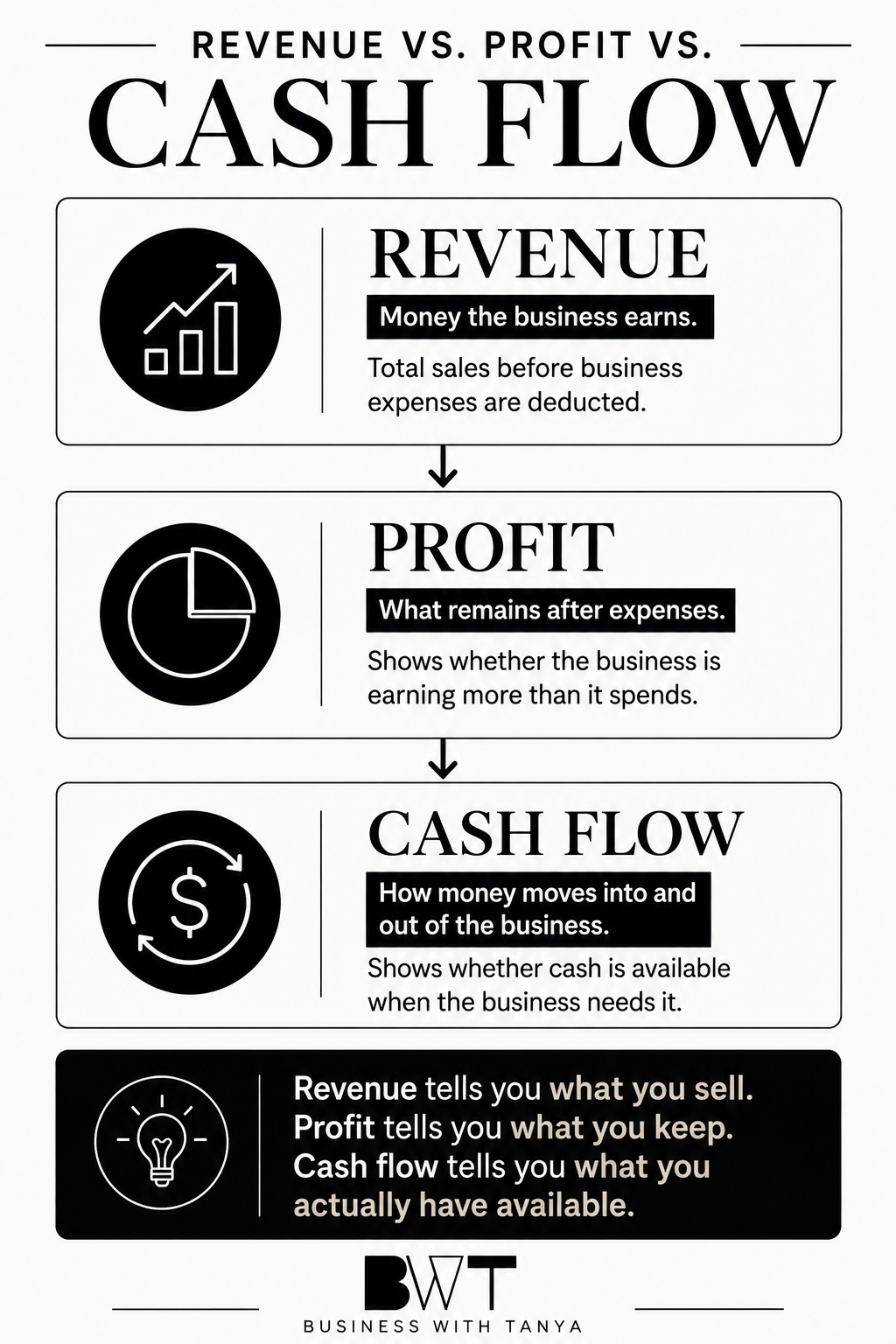
Revenue vs. Profit vs. Cash Flow
Revenue
Money the business earns.
Revenue shows your total sales before expenses are deducted.
It helps you understand how much business you're generating.
Profit
What remains after expenses.
Profit helps you understand whether your business is actually making money after paying its costs.
It provides a clearer picture of financial performance than revenue alone.
Cash Flow
How money moves into and out of the business.
Cash flow helps you understand whether you have enough money available to meet financial obligations as they come due.
All three matter.
But they tell you different things.
Why Strong Revenue Doesn't Always Mean a Healthy Business
One of the easiest mistakes to make is assuming that high revenue equals financial success.
It doesn't necessarily.
A business could generate $1 million in annual revenue and spend $990,000 operating the company.
Another business could generate $500,000 and operate with much stronger margins.
Which business is healthier?
You can't answer that question from revenue alone.
You need more information.
The same applies to cash.
Seeing a large balance in the business bank account can feel reassuring, but some of that money may already be committed to:
Payroll
Taxes
Vendor bills
Loan payments
Upcoming expenses
No single financial number tells the entire story.
Don't Measure Business Success by Sales Alone
Revenue is exciting because it's easy to see.
You land a big client.
Have a record sales month.
Cross a major revenue milestone.
Those achievements matter.
But sustainable businesses aren't built on revenue alone.
They're built by understanding what happens to the money after it's earned.
As your business grows, ask more than:
"How much did we sell?"
Also ask:
"How much did we keep?"
And:
"How much cash do we actually have available?"
Those questions give you a much clearer picture of business health.
Financial Clarity Requires the Full Picture
Revenue tells you one part of the story.
Profit tells you another.
Cash flow adds another layer.
Together, they help you understand what's actually happening inside your business.
You don't need to become a financial expert to run a financially healthy company.
But you should understand the numbers that influence your decisions.
Financial clarity comes from understanding more than how much your business sells. Review revenue, profit, and cash flow together to get a better picture of your business's financial health.
