
What Your Numbers Can Tell You About Your Next Move
Every growing business eventually reaches a point where the owner starts asking:
What's next?
Should you hire another employee?
Invest more in marketing?
Buy new equipment?
Open another location?
Launch a new service?
Raise your prices?
These decisions can shape the future of your business. But too often, they're made based on opportunity, emotion, or what other businesses appear to be doing.
A new opportunity sounds exciting, so you pursue it.
A competitor expands, so you feel like you should expand too.
Business feels busy, so you assume you're ready to hire.
But before asking what your business could do next, there's another question worth asking:
What do your numbers say your business is ready for?
Your Numbers Can Help Guide Your Next Business Decision
Financial reports aren't only useful for taxes or bookkeeping.
They're decision-making tools.
Your revenue trends, profitability, cash flow, expenses, and available financial resources can provide important context before you make a major business move.
Your numbers won't make the decision for you.
But they can help you determine whether the business is financially prepared for it.
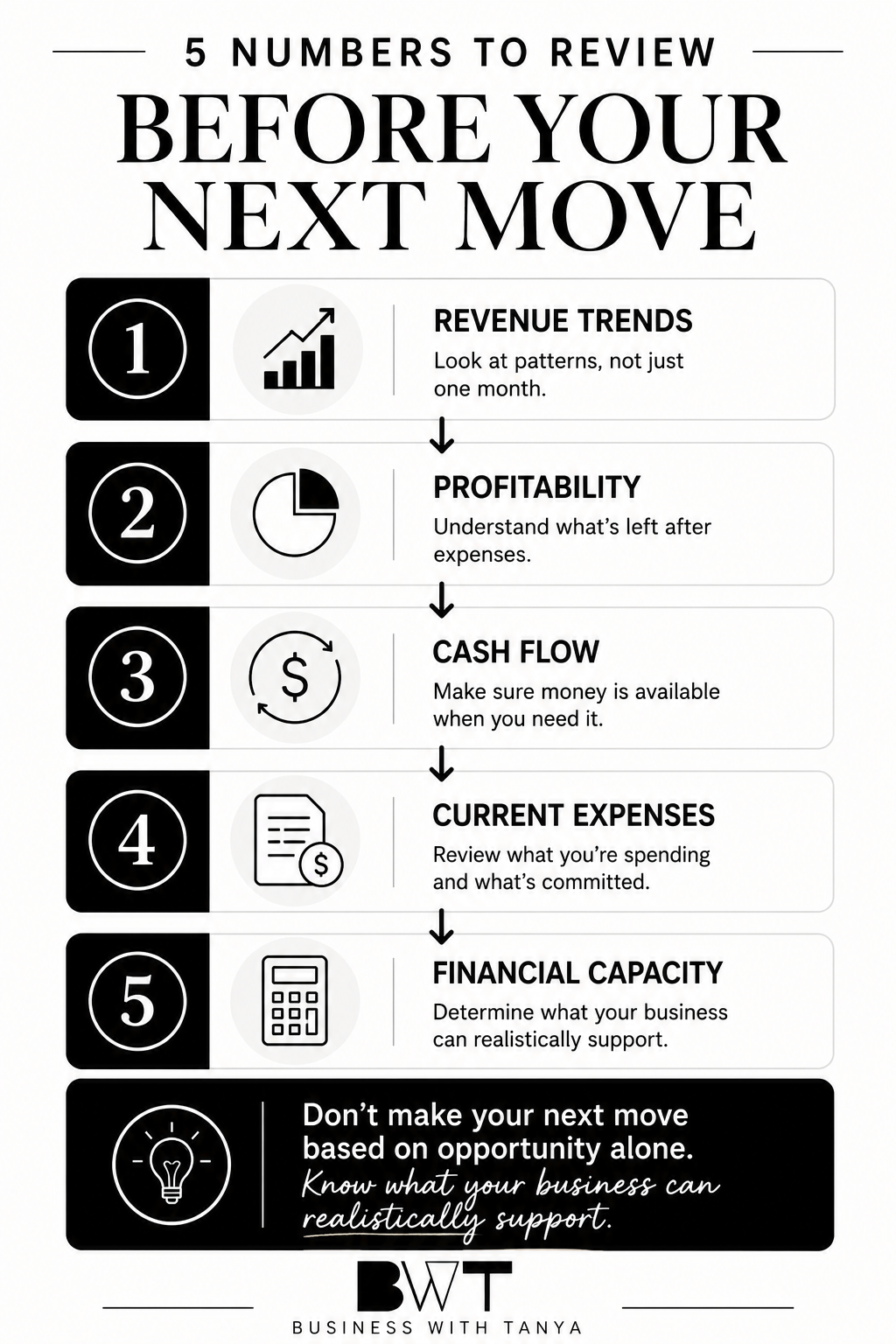
Before making your next move, review these five areas.
1. Review Your Revenue Trends
Start by looking at revenue over time.
Don't base a major decision on one unusually strong month.
Instead, look for patterns.
Ask:
Is revenue consistently increasing?
Is revenue relatively stable?
Are there predictable busy and slow periods?
Is growth coming from repeatable sources?
Was a recent increase temporary or sustainable?
For example, one strong month doesn't necessarily mean you're ready to add a permanent employee.
Several months of consistent growth may tell a different story.
Trends provide more context than individual numbers.
2. Understand Your Profitability
More revenue doesn't automatically mean the business has more money available to invest.
You also need to understand profitability.
If revenue increased by $50,000 but expenses increased by $48,000, the business hasn't gained much additional financial capacity.
Before making a major investment, ask:
Is the business consistently profitable?
Are profit margins improving or shrinking?
Which products or services are most profitable?
Are rising expenses consuming your growth?
Revenue tells you how much the business generates.
Profitability helps tell you how much of that revenue the business actually keeps.
That distinction matters when you're deciding what the business can afford next.
3. Evaluate Your Cash Flow
A profitable business can still run into trouble if it doesn't have enough cash available when bills are due.
That's why cash flow should be part of every major business decision.
Imagine hiring an employee because your business is growing.
The business may be able to afford the employee over the course of the year, but payroll has to be paid consistently — even during slower months.
Before committing to a new recurring expense, consider:
How much cash is currently available?
How predictable is incoming cash?
Are there seasonal slow periods?
What other obligations are coming?
How would this decision affect your cash reserves?
A decision can make sense on paper and still create unnecessary pressure on cash flow.
4. Review Your Current Expenses
Before adding another expense, understand the ones you already have.
Review your current spending and determine how much of your revenue is already committed.
Look at areas such as:
Payroll
Rent
Software
Marketing
Insurance
Contractors
Equipment
Debt payments
Professional services
Other recurring expenses
This can help you understand how much flexibility actually exists within the business.
You may also discover expenses that can be reduced or eliminated before taking on something new.
5. Determine What the Business Can Realistically Support
Now bring everything together.
You've reviewed revenue.
You understand profitability.
You've evaluated cash flow.
You've looked at current expenses.
The final question is:
What can the business realistically support?
Not what could work if everything goes perfectly.
Not what you hope future growth will pay for.
What can the business reasonably support based on its current financial position?
That might mean you're ready to move forward.
It might mean you need another six months of growth.
Or it might show you that a different investment should come first.
Waiting isn't always a sign that your business isn't growing.
Sometimes waiting is the more strategic decision.
Decision Without Financial Clarity vs. Decision With Financial Clarity
Decision Without Financial Clarity
The thought process often sounds like:
"This feels like the right move."
The owner may:
Focus primarily on the opportunity
Assume future growth will cover the cost
React quickly
Overlook cash flow
Hope the numbers work
Decision With Financial Clarity
The owner:
Reviews financial performance
Calculates the potential cost
Considers the impact on cash flow
Evaluates financial risk
Makes a more informed decision
Both business owners may ultimately make the same decision.
The difference is that one understands the financial impact before moving forward.
Your Numbers Don't Make the Decision — You Do
There are parts of running a business that can't be measured perfectly on a financial statement.
Vision matters.
Timing matters.
Opportunity matters.
Experience and instinct matter.
Your numbers cannot tell you exactly what to do.
But they can tell you about the financial reality surrounding the decision.
That's valuable information.
If an opportunity requires $30,000, you should understand what a $30,000 investment would mean for your cash flow.
If you're considering hiring, you should understand whether current profitability can support the additional payroll.
If you're considering expansion, you should understand whether existing operations are financially strong enough to support it.
Financial clarity doesn't eliminate risk.
It helps you understand the risk you're taking.
Before You Decide What's Next, Know Where You Stand
Growth isn't about saying yes to every opportunity.
It's about knowing which opportunities your business is prepared to support.
Before making your next major move, review what your current numbers are telling you.
Look at your revenue trends.
Understand your profitability.
Evaluate your cash flow.
Review your expenses.
Determine your financial capacity.
Then make the decision.
Financial clarity creates a stronger foundation for strategic growth.
