
The Monthly Money Check-In Every Business Owner Needs
Running a business means making financial decisions constantly.
You decide when to hire, what to spend on marketing, whether you can afford new equipment, when to increase prices, and where your money should go next.
But many business owners make these decisions without regularly reviewing what is actually happening financially.
Instead, they check their bank balance, pay bills as they come in, and take a closer look at the numbers only when taxes are approaching or something feels wrong.
A simple monthly money check-in can change that.
Why Business Owners Need a Monthly Financial Check-In
You don't need to analyze your finances every day.
But you do need a consistent time to review them.
A monthly money check-in gives you dedicated time to look at the financial health of your business and answer important questions:
How much revenue did we generate?
Where did our money go?
Did we make a profit?
How is our cash flow?
What expenses are coming up?
Is there anything that needs my attention?
The goal isn't to become an accountant.
The goal is to understand your business well enough to make informed decisions.
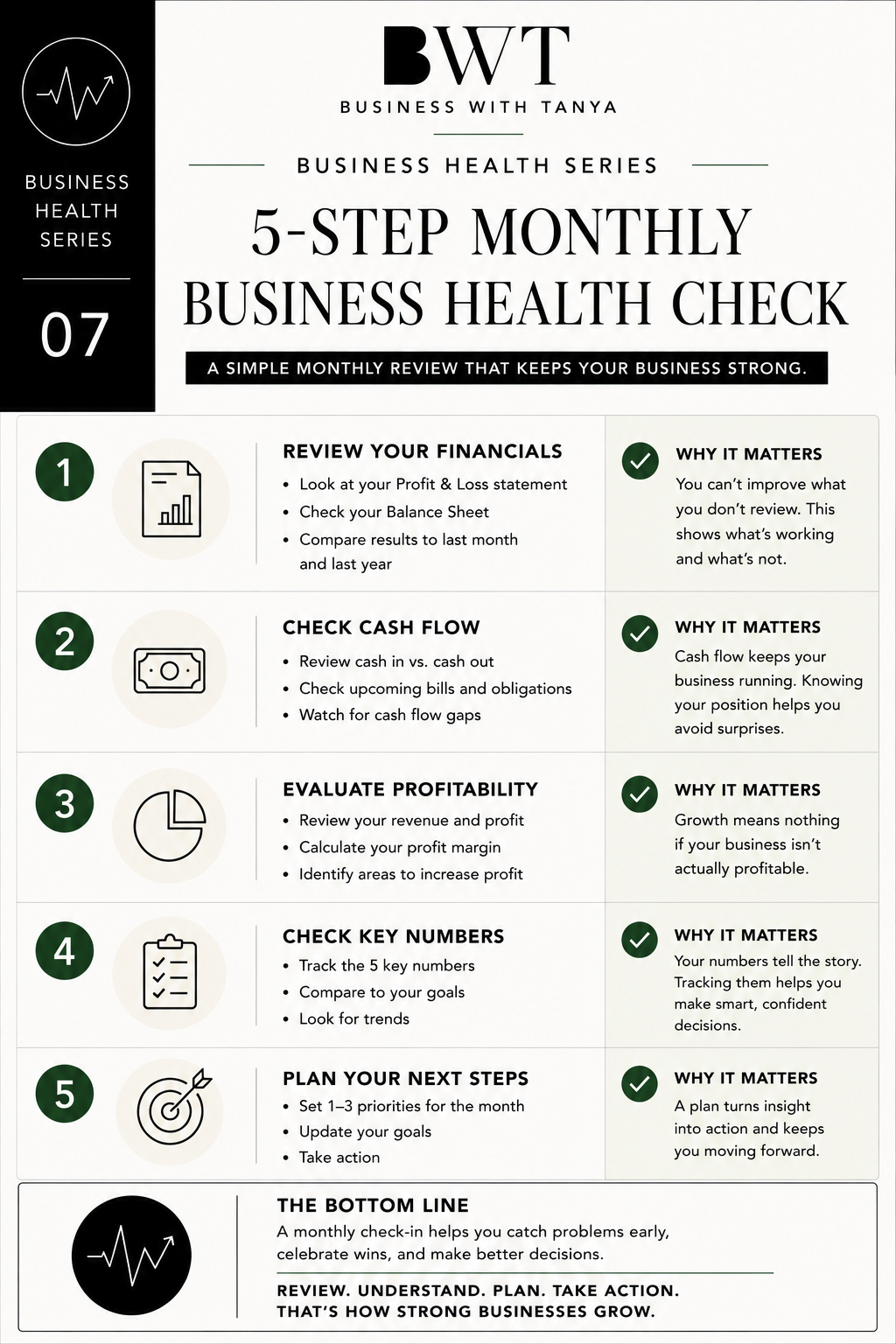
Here's a simple five-step monthly review.
1. Review Your Monthly Revenue
Start with the money your business brought in during the month.
Look at your total revenue and compare it with previous months.
Ask yourself:
Did revenue increase or decrease?
Was the change expected?
Which products or services generated the most revenue?
Are there noticeable patterns?
Are you on track with your revenue goals?
Don't panic over one slower month. You're looking for patterns over time.
Consistently tracking revenue helps you understand whether your business is moving in the direction you expect.
2. Review Your Expenses
Revenue only tells you part of the story.
Next, look at what your business spent.
Review major expense categories and pay attention to anything that increased unexpectedly.
You may notice:
Software subscriptions you aren't using
Higher supply costs
Increased payroll expenses
Marketing expenses that have grown
Recurring charges that need to be reviewed
The goal isn't to eliminate every expense.
It's to make sure your money is being spent intentionally.
A business can generate more revenue while becoming less profitable if expenses are growing even faster.
3. Check Your Profit and Cash Flow
Your bank balance doesn't tell you whether your business is financially healthy.
That's why your monthly check-in should include both profit and cash flow.
Profit helps you understand whether your business earned more than it spent over a period of time.
Cash flow helps you understand how money is actually moving in and out of the business.
You can have a profitable business and still experience cash flow problems.
Likewise, having money in the bank doesn't automatically mean your business had a profitable month.
Understanding both gives you a much clearer picture of your financial position.
4. Look at Upcoming Financial Obligations
Your monthly review shouldn't only look backward.
It should also help you prepare for what's coming next.
Look at upcoming expenses such as:
Payroll
Taxes
Insurance
Loan payments
Vendor payments
Equipment purchases
Annual subscriptions
Large upcoming projects
Knowing these expenses are coming allows you to plan for them instead of being surprised when they're due.
This is one of the biggest advantages of reviewing your finances consistently: you can become more proactive instead of reactive.
5. Identify One Financial Priority for Next Month
End your monthly money check-in by deciding what deserves your attention next.
Keep it simple.
Your priority might be:
Reduce one unnecessary expense
Increase your cash reserve
Follow up on outstanding invoices
Review your pricing
Prepare for an upcoming tax payment
Improve a low-performing service
Create a budget for an upcoming investment
You don't need to fix everything at once.
Choose one financial priority that can strengthen the business over the next month.
Then revisit it during your next check-in.
Without a Monthly Check-In vs. With a Monthly Check-In
Without a Monthly Check-In
The business owner may:
Look at finances only when problems happen
Rely heavily on the bank balance
Miss changes in spending
React to cash flow problems
Make decisions with limited information
With a Monthly Check-In
The business owner:
Reviews finances consistently
Understands revenue and expenses
Watches profitability
Plans for upcoming expenses
Makes decisions with greater clarity
The numbers haven't necessarily changed.
Your understanding of them has.
And that understanding can change the way you run your business.
Your Monthly Financial Review Doesn't Need to Take Hours
One reason business owners avoid reviewing their finances is because they assume it needs to be complicated.
It doesn't.
You don't need to spend an entire day analyzing spreadsheets or reviewing every transaction.
If your bookkeeping is organized and your financial reports are up to date, you should be able to focus on a handful of important numbers and questions.
The purpose of the monthly check-in is consistency.
Thirty focused minutes every month can be more valuable than ignoring your finances for six months and trying to understand everything at once.
Financial Clarity Comes From Paying Attention
Financial clarity isn't something you gain once and keep forever.
Your business changes.
Revenue changes. Expenses change. Cash flow changes. Priorities change.
That's why reviewing your numbers needs to become part of how you operate your business.
A monthly money check-in creates a simple rhythm:
Review what happened. Understand where you stand. Prepare for what's coming. Decide what needs attention next.
You don't need to know every number in your business at all times.
But as the owner, you should understand the numbers that tell you whether your business is moving forward.
Because better business decisions start with knowing where you actually stand
