
Why Successful CEOs Schedule Thinking Time
Most business owners believe they need more hours in the day.
More time.
More staff.
More productivity.
But the truth is that most business owners do not have a time problem.
They have a clarity problem.
The most successful CEOs understand something many entrepreneurs overlook: growth does not come from constantly doing more. Growth comes from making better decisions.
And better decisions require time to think.
If every moment of your day is spent responding to emails, solving problems, managing clients, and putting out fires, there is very little space left for strategy.
That is why successful CEOs schedule thinking time.
Direct Answer
Successful CEOs schedule thinking time because strategic growth requires intentional decision-making. Creating dedicated space to think allows leaders to identify opportunities, solve problems, and guide their businesses with clarity instead of constantly reacting to daily demands.
1. Block Thinking Time on Your Calendar
If thinking time is not scheduled, it usually does not happen.
Most business owners fill their calendars with meetings, client work, and operational tasks. Strategic thinking gets pushed aside because it does not feel urgent.
Successful CEOs treat thinking time like an important meeting.
They schedule it.
They protect it.
And they show up for it consistently.
Even one hour each week can create significant clarity and momentum.
2. Eliminate Distractions
Strategic thinking requires focus.
Notifications, emails, phone calls, and interruptions make it difficult to think deeply about the future of your business.
When you schedule thinking time:
Silence notifications
Close unnecessary tabs
Step away from daily operations
Create a quiet environment
The goal is not productivity.
The goal is perspective.
Many of the best business decisions happen when distractions are removed.
3. Review Your Goals and Priorities
Thinking time provides an opportunity to step back and evaluate where your business is headed.
Ask yourself:
Are we moving toward our goals?
What is working well?
What is slowing growth?
What needs attention right now?
What should become a priority next quarter?
Without regular reflection, it is easy to spend months busy but moving in the wrong direction.
Clarity creates alignment.
Alignment creates growth.
4. Identify Problems Before They Become Crises
Most business challenges do not appear overnight.
They usually develop slowly.
Thinking time allows you to identify:
Operational bottlenecks
Team challenges
Financial concerns
Customer experience issues
Growth obstacles
When leaders create space to evaluate problems early, they can solve them before they become expensive emergencies.
Proactive leadership almost always beats reactive leadership.
5. Create a Plan for What Comes Next
Thinking without action creates little value.
The purpose of strategic thinking is to create direction.
Before ending your thinking session, identify:
Key priorities
Important decisions
Necessary changes
Next action steps
The most effective CEOs leave their thinking time with a clear plan instead of simply collecting ideas.
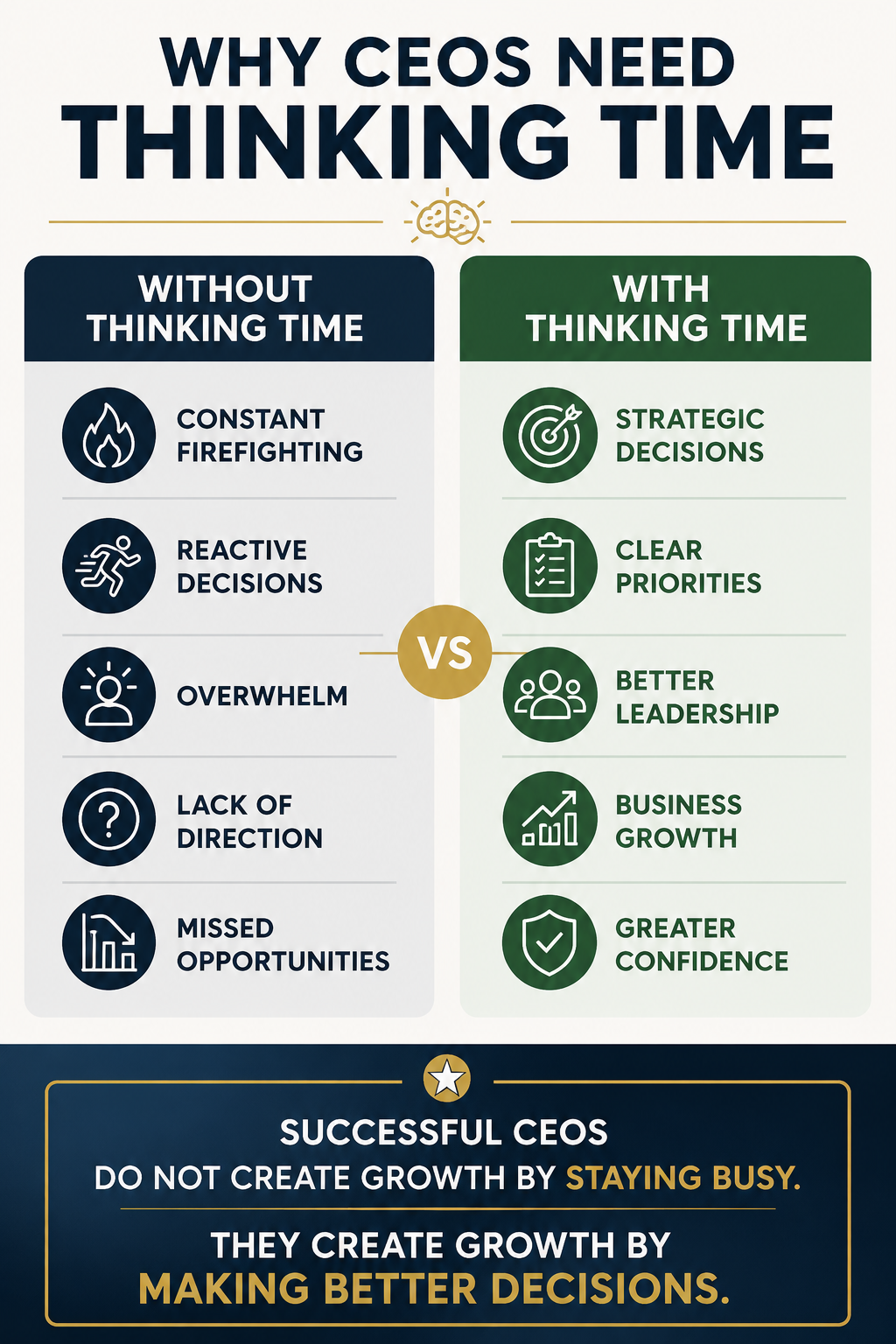
Thinking Time vs Constant Activity
Reactive CEO
Constantly busy
Solving today's problems
Overwhelmed by daily demands
Limited strategic focus
Makes rushed decisions
Intentional CEO
Creates space to think
Plans proactively
Focuses on long-term growth
Operates with clarity
Makes strategic decisions
Reality Check
Many business owners wear being busy like a badge of honor.
But being busy is not the same as being effective.
The CEOs who build sustainable businesses are not necessarily the ones working the most hours.
They are often the ones making the best decisions.
And those decisions usually happen because they intentionally create time to think.
If you never pause long enough to evaluate your business, you may spend years working hard without making meaningful progress.
Final Thoughts
Your business can only grow as fast as your ability to lead it.
Leadership requires more than action.
It requires clarity.
Successful CEOs understand that strategic thinking is not a luxury. It is a responsibility.
The next level of growth may not require more effort.
It may require more intentional thinking.
When was the last time you intentionally stepped away from your business to review both your strategy and your numbers?
Many business owners spend time planning growth but never evaluate the financial systems supporting it. Clarity starts with knowing where your business stands today.
