
What No One Tells You About Running a Small Business
Most people think running a small business is mainly about:
freedom
flexibility
income
independence
growth
And while those things can absolutely happen, there’s another side of entrepreneurship that people rarely talk about.
But running a business requires:
constant decision-making
emotional resilience
financial awareness
systems
structure
consistency
The hard part is not simply starting the business.
It is learning how to lead yourself while carrying the responsibility of the business every day.
Because eventually, business growth stops being only about strategy.
It becomes about leadership capacity.
The Direct Answer
What no one tells you about running a small business is that the workload is not only physical.
It is mental, emotional, and operational too.
Small business owners are constantly:
making decisions
solving problems
managing responsibilities
thinking ahead
handling uncertainty
carrying pressure behind the scenes
And without structure, clarity, and boundaries, that pressure can quickly become overwhelming.
Strong businesses are not built only through motivation.
They are built through:
systems
consistency
leadership
emotional regulation
financial clarity
sustainable habits
Because long-term growth requires more than ambition.
It requires stability.
The How-To Steps
1. Build Systems Earlier Than You Think You Need Them
Many business owners wait until they feel overwhelmed before building structure.
Strong systems create:
clarity
consistency
organization
better decision-making
less emotional pressure
Systems may include:
bookkeeping routines
scheduling processes
communication standards
client workflows
financial tracking
The earlier structure is built, the easier growth becomes to sustain.
Because chaos eventually slows growth down.
2. Learn to Manage Your Mental Energy
Small business ownership requires constant thinking:
solving problems
making decisions
handling uncertainty
managing responsibilities
shifting priorities
Over time, this creates mental fatigue.
Strong leaders protect their mental energy by:
reducing unnecessary chaos
simplifying decisions
creating routines
setting boundaries
protecting their focus
prioritizing clarity
Because exhaustion affects leadership quality.
And unclear leadership often creates unstable businesses.
3. Financial Clarity Reduces Emotional Stress
A surprising amount of business stress comes from unclear finances.
When business owners avoid:
bookkeeping
cash flow tracking
financial organization
tax planning
it often creates:
uncertainty
reactive decisions
overwhelm
unnecessary pressure
Financial clarity creates stability.
And stability improves confidence, decision-making, and long-term planning.
The more clearly you understand your business financially, the more grounded your leadership becomes operationally.
4. Consistency Matters More Than Motivation
Many people start businesses feeling highly motivated.
But motivation changes.
Long-term business growth usually comes from:
discipline
routines
follow-through
consistency
intentional leadership
Strong businesses are not built through emotional highs.
They are built through repeated leadership behaviors over time.
Some days will feel exciting.
Other days will feel exhausting.
The ability to continue showing up consistently is often what separates sustainable businesses from unstable ones.
5. Boundaries Protect Long-Term Growth
Many business owners unintentionally build businesses that consume their entire identity.
Without boundaries, growth often leads to:
burnout
emotional exhaustion
poor decisions
inconsistent leadership
unstable momentum
Strong boundaries help protect:
focus
relationships
health
leadership quality
long-term sustainability
Because sustainable growth requires sustainable leadership.
And sustainable leadership requires capacity.
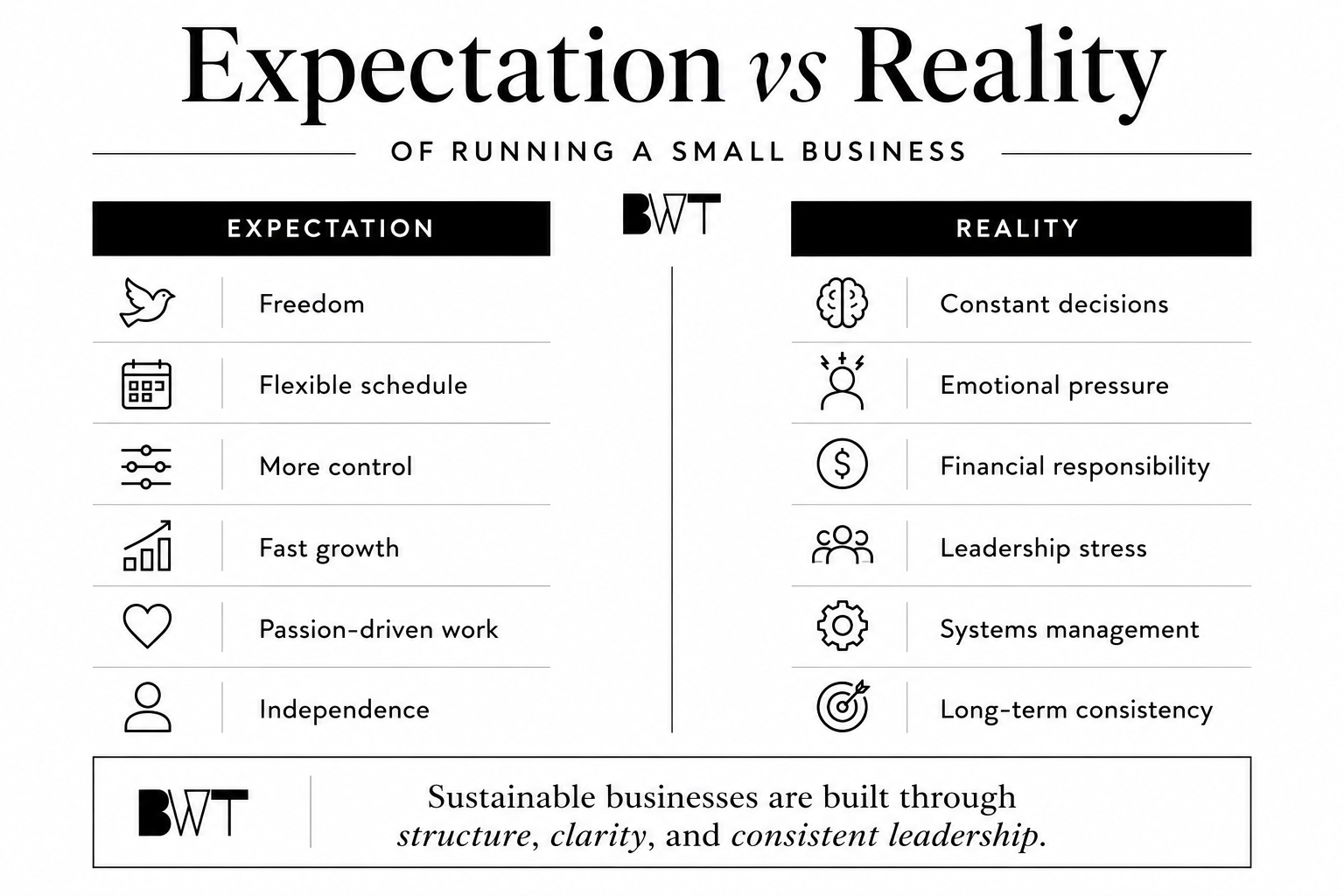
The Comparison
Expectation
freedom
flexible schedule
passion-driven work
independence
fast growth
more control
Reality
constant decisions
emotional pressure
financial responsibility
leadership stress
systems management
long-term consistency
The Reality Check
Most small business owners are not struggling because they lack ambition.
They are struggling because no one prepared them for:
the mental weight of leadership
the emotional responsibility of decision-making
the importance of systems
the pressure of uncertainty
the need for self-leadership
Running a business is not only operational.
It is deeply personal.
Because the business often reflects the clarity, habits, and leadership of the person running it.
And eventually, disorganization creates stress.
Reactive leadership often creates instability.
And unclear systems create overwhelm.
Strong businesses are rarely built accidentally.
They are built intentionally.
If you want to build a business with more clarity, structure, and sustainable leadership:
Discover Your Clarity Point
Strong businesses are built by leaders who understand how to create systems, stability, and intentional growth.
