
The Difference Between Activity and Progress
Being busy can feel productive.
Your calendar is full. Your inbox never stops. You are answering questions, attending meetings, serving clients, solving problems, and checking tasks off your list.
At the end of the day, you may feel exhausted.
But did the business actually move forward?
There is an important difference between activity and progress. Successful business owners learn to recognize that difference.
Activity keeps you moving.
Progress moves the business forward.
The Problem: Being Busy Can Look Like Growth
Business owners rarely struggle to find something to do.
There is always another email to answer, meeting to attend, task to complete, or problem to solve.
The problem is that being busy can create the illusion of progress.
You can spend an entire week working without making meaningful progress toward your biggest goals.
You may be generating more revenue without increasing profit.
You may be gaining more customers while your expenses grow even faster.
You may be working longer hours without building systems that allow the business to operate more efficiently.
If you only measure how busy you are, you may miss what is actually happening inside the business.
The Direct Answer: Activity Is What You Do. Progress Is What Changes.
Activity is completing tasks.
Progress is achieving measurable results.
The difference comes down to outcomes.
Sending 50 sales emails is activity.
Increasing qualified leads is progress.
Posting on social media every day is activity.
Increasing website traffic, inquiries, or conversions is progress.
Reviewing financial reports is activity.
Using those reports to improve cash flow or profitability is progress.
The goal is not to eliminate activity. Every business requires work.
The goal is to make sure your activity is connected to a result that matters.
How to Turn Activity Into Progress
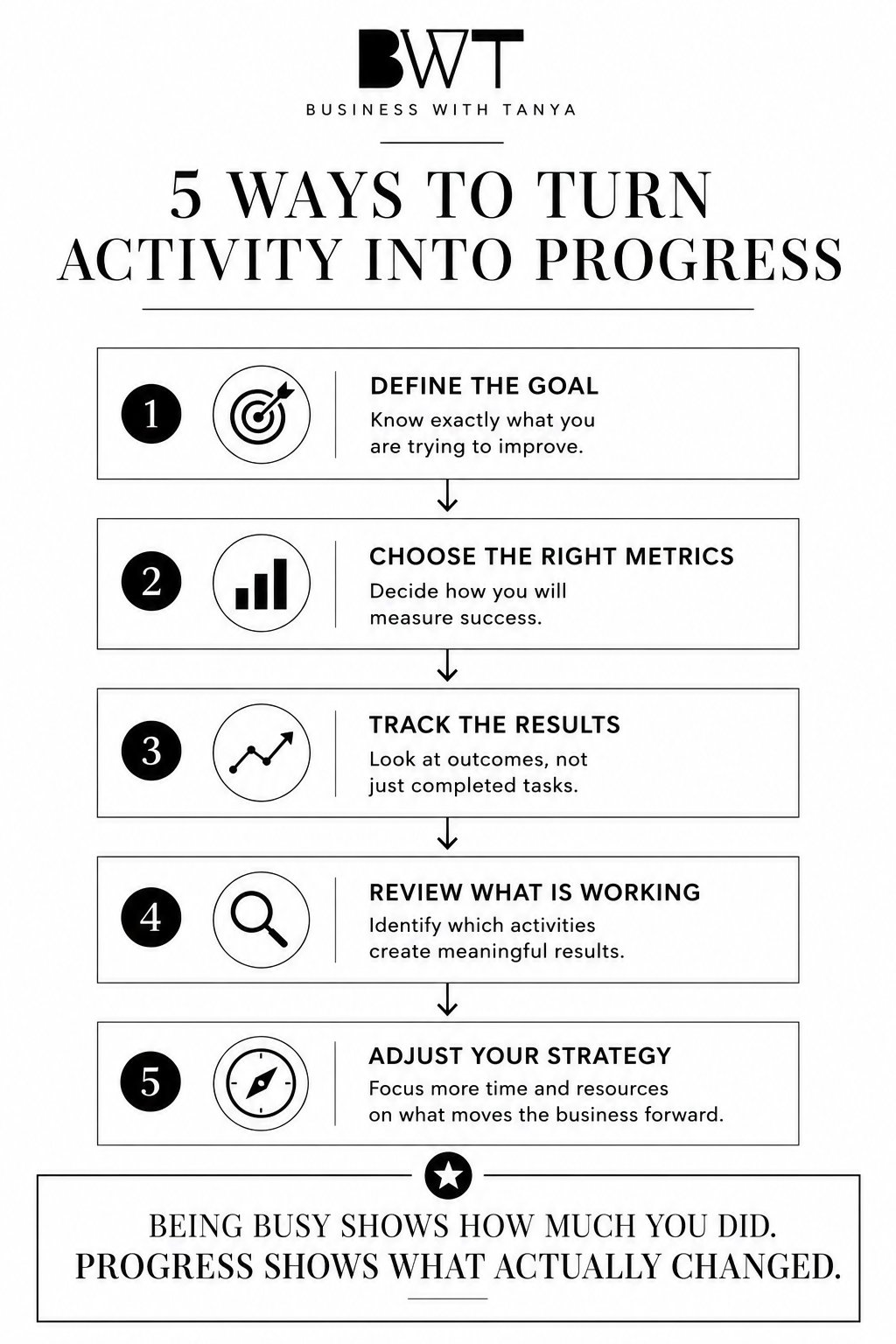
Step 1: Define What Progress Looks Like
Before you start working toward a goal, decide how you will know if you are succeeding.
Instead of saying, "We need to grow," identify what growth actually means.
Is the goal higher revenue? Better profit margins? More recurring clients? Stronger cash flow?
Clear goals make progress easier to recognize.
Step 2: Identify the Numbers That Matter
Every important goal should have a way to measure it.
If your goal is improving profitability, track profit margins.
If your goal is improving financial stability, monitor cash flow.
If your goal is growing the business, look beyond revenue and understand what that growth is costing you.
Your numbers help you separate movement from meaningful progress.
Step 3: Review Results, Not Just Tasks
Do not only ask, "What did we accomplish this week?"
Ask, "What changed because of what we did?"
That question creates a different level of accountability.
Step 4: Stop Doing Work That Does Not Move the Business Forward
Some tasks are necessary. Others continue because they have always been done.
Regularly review where you and your team are spending time.
If an activity consistently produces little value, consider eliminating, automating, or delegating it.
Step 5: Use Your Financials as a Reality Check
Financial numbers often reveal whether your activity is producing real progress.
Revenue, profit, expenses, and cash flow can show whether the business is actually becoming stronger.
Comparison: Activity vs. Progress
Activity:
Staying busy all day.
Completing more tasks.
Attending more meetings.
Increasing revenue without reviewing profit.
Reacting to whatever feels urgent.
Measuring how much work was completed.
Progress:
Working toward clear priorities.
Achieving measurable results.
Holding meetings that lead to decisions.
Understanding whether growth is profitable.
Focusing on what moves the business forward.
Measuring what changed because of the work.
The question is not simply, "What did we do?"
The better question is, "What improved?"
The Reality Check: Hard Work Does Not Always Equal Progress
You can work incredibly hard and still move in the wrong direction.
This is especially true when financial information is unclear.
A business owner may celebrate record revenue without realizing expenses increased even faster.
A company may add new clients while creating cash flow problems.
A CEO may hire more employees without understanding whether the business can sustainably support the additional payroll.
Without clear numbers, activity can hide problems.
Progress requires measurement.
The Bigger Picture: Great CEOs Focus on Outcomes
Strong leaders understand that their job is not to be the busiest person in the company.
Their job is to move the company forward.
That requires stepping away from the daily activity long enough to ask bigger questions.
What is working?
What is not?
What are our numbers telling us?
Where are we making progress?
Where are we simply staying busy?
When you understand the answers, you can focus your time, money, and energy on the areas that create the greatest impact.
Are You Busy or Are You Making Progress?
Look at the last 90 days of your business.
You probably completed hundreds of tasks.
But what actually improved?
Did profitability increase?
Did cash flow become stronger?
Did your systems improve?
Did the business become less dependent on you?
If you cannot answer those questions, it may be time to look beyond your to-do list and start measuring your results.
Because activity can make you feel productive.
Progress gives you proof that the business is moving forward.
