
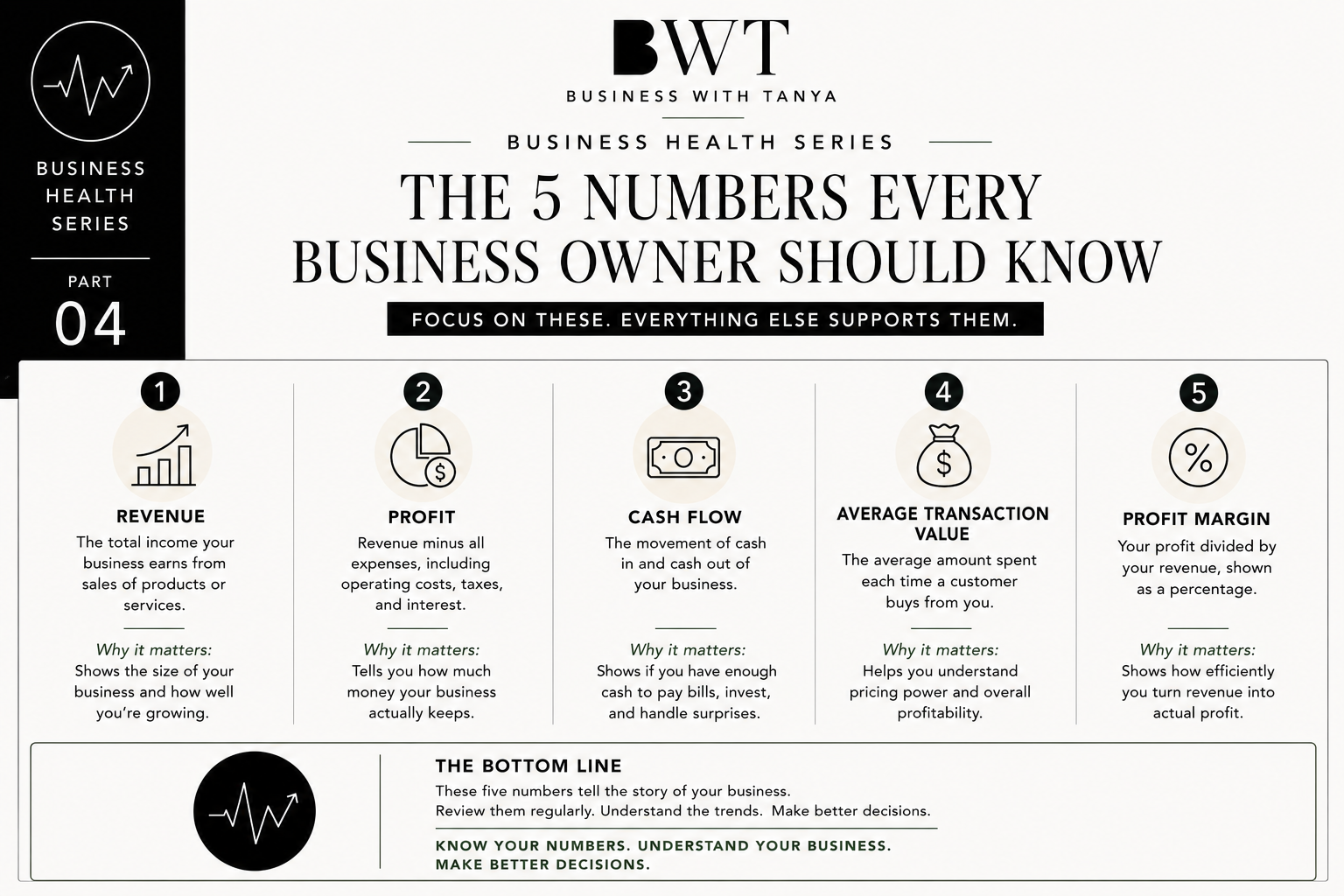
The 5 Numbers Every Business Owner Should Know Business Health Series | Part 4
You don't need to be an accountant to understand the financial health of your business.
And you don't need to memorize every number on every financial report.
What you do need is a clear understanding of a few key numbers that can help you answer important questions:
Are we growing?
Are we profitable?
Do we have enough cash?
Is the business becoming financially stronger?
When you know which numbers to watch, financial reports become much more useful—and business decisions become easier to make.
The Direct Answer: What Numbers Should Every Business Owner Know?
Start with these five:
Revenue
Gross Profit
Net Profit
Cash Flow
Cash on Hand
Each tells you something different about your business.
Together, they give you a much clearer picture of its financial health.
1. Revenue
Revenue is the money your business generates from selling its products or services before expenses are deducted.
If your business generated $75,000 in sales this month, your revenue is $75,000.
Revenue helps you understand:
How much the business is selling
Whether sales are growing
Which months are strongest
Whether you're reaching your sales goals
How revenue compares with previous periods
But as we've already covered in the Business Health Series, revenue isn't profit.
A company can generate a lot of revenue while keeping very little of it.
That's why revenue should never be reviewed by itself.
2. Gross Profit
Gross profit helps you understand how much money remains after the direct costs required to deliver what you sell.
At a basic level:
Revenue – Cost of Goods Sold = Gross Profit
For a product-based company, those costs might include materials or inventory.
For some service businesses, they may include certain direct labor or other costs associated with providing the service.
Gross profit can help you identify problems with:
Pricing
Labor costs
Materials
Product costs
Service delivery
If revenue is increasing but gross profit isn't keeping up, that's worth investigating.
Your business may be selling more without making enough on those sales.
3. Net Profit
Net profit takes the picture further.
This is what remains after the business's expenses are accounted for.
Expenses can include things like:
Payroll
Rent
Marketing
Insurance
Software
Professional services
Office expenses
Other operating costs
Imagine your business generates:
$100,000 in revenue
and after applicable costs and expenses, the business has:
$15,000 in net profit.
That $15,000 tells you much more about the financial performance of the company than the $100,000 revenue number alone.
Tracking net profit over time can also help you see whether the business is becoming more or less profitable as it grows.
4. Cash Flow
Profit tells you about financial performance.
Cash flow tells you how money is actually moving through the business.
You can have a profitable business and still experience cash flow problems.
For example, you might have:
Customers who haven't paid invoices yet
Large bills due before customer payments arrive
Equipment purchases
Debt payments
Tax obligations
Seasonal changes in revenue
That's why looking only at profit can leave part of the story out.
You need to understand whether enough cash is coming into the business at the right time to cover what's going out.
5. Cash on Hand
Finally, know how much cash your business actually has available.
This doesn't mean checking your bank balance and assuming all of that money is available to spend.
Some of it may already be needed for:
Payroll
Taxes
Vendor bills
Debt payments
Upcoming expenses
Planned purchases
Instead, you want to understand how much cash the business has and what that cash needs to cover.
Cash on hand gives you insight into how much flexibility the business has if something unexpected happens or an opportunity appears.
What Does This Look Like in Real Life?
Imagine you're considering hiring another employee.
Revenue has been increasing, and your team is busy.
It would be easy to think:
“We're growing. We can afford another employee.”
But before making that decision, you review your five numbers.
Revenue: Growing consistently
Gross Profit: Stable
Net Profit: Improving
Cash Flow: Positive but occasionally tight
Cash on Hand: Enough to cover current obligations, but reserves are still being built
Now you have a much better picture.
Maybe you decide the business can support the hire.
Or maybe you decide to wait another few months and strengthen your cash position first.
Either way, the decision isn't based only on how busy the business feels.
It's based on what the numbers are telling you.
You Don't Need to Watch Every Number Every Day
Financial visibility doesn't mean obsessing over your reports.
For many business owners, a consistent monthly review can be much more valuable than constantly checking the bank account.
Create a simple CEO dashboard that includes:
Revenue
Gross Profit
Net Profit
Cash Flow
Cash on Hand
Then compare those numbers over time.
Ask:
What changed?
Why did it change?
Is there anything that needs our attention?
What decision should we make because of it?
That's when numbers become useful.
The CEO Takeaway
You don't need more financial information.
You need the right financial information.
Start with five numbers:
Revenue.
Gross profit.
Net profit.
Cash flow.
Cash on hand.
Review them consistently, understand how they work together, and use them to make better decisions.
Because financial clarity isn't about becoming an accountant.
It's about becoming a more informed CEO.
Continue the Business Health Series
Next: How Much Cash Should Your Business Keep on Hand?
In Part 5 of the Business Health Series, we'll look at how to think about business cash reserves and how to determine a reasonable target based on the way your business actually operates.
