
How Much Cash Should Your Business Keep on Hand? Business Health Series | Part 5
Having money in the bank can make your business feel financially secure.
But how much cash should you actually keep on hand?
Is one month of expenses enough? Three months? Six months?
The answer isn't the same for every business.
A company with predictable monthly revenue may have very different cash needs than a seasonal business, a growing company, or a business that depends heavily on a few large clients.
Instead of choosing an arbitrary number, business owners should think about cash reserves based on how their business actually operates.
The Direct Answer: How Much Cash Should a Business Keep on Hand?
There is no single cash reserve amount that works for every business.
The right amount depends on factors such as:
Monthly operating expenses
Revenue consistency
Seasonality
Upcoming obligations
Customer concentration
Debt
Business risk
Growth plans
The goal is to have enough cash available to give the business breathing room when revenue changes, unexpected expenses appear, or opportunities arise.
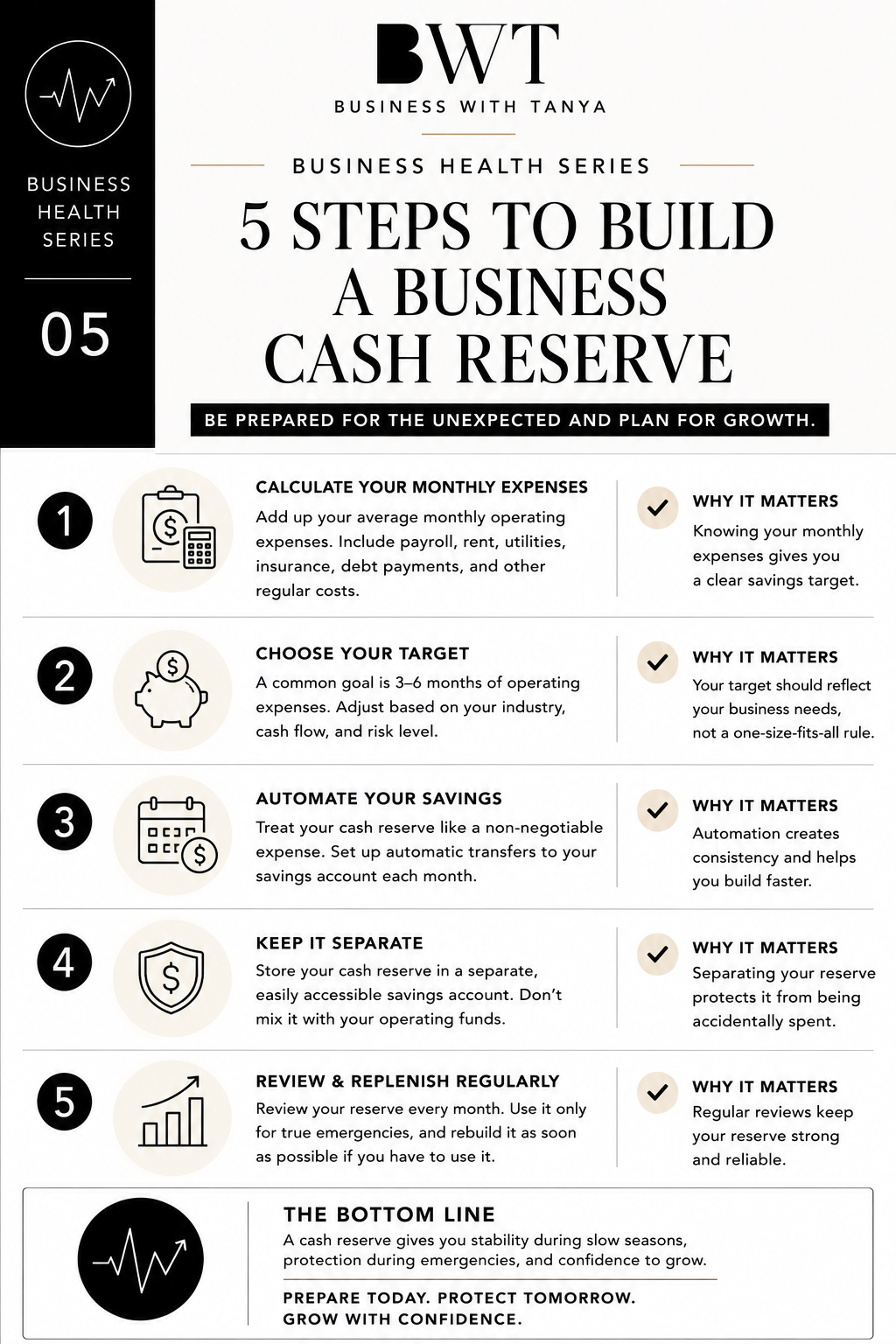
Here are five areas to consider when determining what makes sense for your business.
1. Know Your Essential Monthly Expenses
Start by understanding what it costs to keep the business operating each month.
Focus first on essential expenses such as:
Payroll
Rent
Insurance
Core software
Utilities
Debt payments
Essential contractors
Other required operating costs
Imagine your business needs approximately $25,000 per month to cover essential expenses.
That number gives you a starting point.
Instead of randomly deciding that $50,000 sounds like a good cash reserve, you can evaluate what that amount actually represents.
In this example, $50,000 would cover roughly two months of essential expenses.
That context makes the number much more useful.
2. Consider How Predictable Your Revenue Is
Not every business receives money the same way.
Some businesses have recurring monthly revenue.
Others rely on individual projects, seasonal sales, large contracts, or customers who may take weeks to pay.
Ask:
Is our revenue fairly predictable?
Do we experience slow seasons?
How quickly do customers typically pay?
Do a few customers represent a large portion of our revenue?
What would happen if a major client left?
The less predictable your revenue is, the more important it may be to create additional financial breathing room.
3. Separate Cash Reserves From Money You Already Owe
Seeing a large bank balance can create a false sense of security.
Not all of that money is necessarily available.
Some of it may already be needed for:
Payroll
Payroll taxes
Income taxes
Sales taxes
Vendor bills
Debt payments
Upcoming purchases
Other committed expenses
For example, your business might have $100,000 in the bank.
But if $40,000 is needed for upcoming payroll, taxes, bills, and other obligations, you don't really have $100,000 available as a reserve.
You have to understand what the cash is already responsible for.
This is another reason your bank balance alone doesn't tell you the financial health of your business.
4. Think About Your Business Risks
Cash reserves help businesses handle uncertainty.
Different businesses face different risks.
Consider what could realistically disrupt yours.
For example:
A service business might lose a major client.
A restaurant might experience an equipment failure.
A construction company might have a customer delay payment.
A seasonal company might experience a slower-than-expected season.
A growing company might need to cover payroll before new revenue catches up.
You don't need to plan for every possible disaster.
But you should understand the risks most likely to affect your business.
Then ask:
If this happened tomorrow, would we have enough cash to respond without immediately creating a financial crisis?
That question can help you evaluate whether your current cash position gives the business enough flexibility.
5. Create a Cash Reserve Target
Once you understand your expenses, revenue patterns, obligations, and risks, you can create an intentional cash reserve target.
You might start by asking:
How many months of essential operating expenses would we like available?
Then determine what that means in dollars.
If essential expenses are:
$30,000 per month
then:
1 month = $30,000
2 months = $60,000
3 months = $90,000
This doesn't mean every business needs exactly three months of cash.
The appropriate target depends on the company.
What's important is having a reason behind the number.
Your cash reserve shouldn't simply be:
“Whatever happens to be left in the account.”
It should be something you're intentionally building toward.
What Does This Look Like in Real Life?
Imagine two businesses.
Both have $75,000 in cash.
Business A
Essential monthly expenses: $15,000
Revenue: Predictable recurring contracts
Customer base: Diversified
Upcoming obligations: Fully planned
That $75,000 may provide significant financial flexibility.
Business B
Essential monthly expenses: $40,000
Revenue: Project-based and inconsistent
Customer base: Two major clients
Upcoming tax payment: Due soon
Same bank balance.
Completely different financial position.
That's why asking:
“How much money should a business have in the bank?”
isn't enough.
The better question is:
“How much cash does our business need based on how it actually operates?”
Cash Gives Your Business Options
Cash isn't only useful during emergencies.
A healthy cash position can also help your business take advantage of opportunities.
You may be able to:
Hire when the right person becomes available
Purchase equipment
Invest in marketing
Handle a slow month
Make a strategic investment
Avoid unnecessary debt
Prepare for taxes
Take advantage of an unexpected opportunity
Cash creates flexibility.
And flexibility gives business owners more choices.
Review Your Cash Target as the Business Grows
Your reserve target shouldn't stay the same forever.
If your business grows from:
$20,000 in monthly expenses
to
$50,000 in monthly expenses
the amount of cash required to create the same level of financial protection changes too.
Review your cash position as part of your regular financial review.
Ask:
What are our essential monthly expenses now?
How predictable is our revenue?
What obligations are coming up?
What risks have changed?
Are our reserves keeping up with the business?
Cash planning should evolve as the company evolves.
The CEO Takeaway
There isn't one perfect cash reserve number for every business.
The goal is to understand what your business needs.
Start with:
Essential expenses.
Revenue consistency.
Upcoming obligations.
Business risks.
Your reserve target.
Then build toward a cash position that gives your business enough room to operate, adapt, and make decisions with confidence.
Because having cash isn't just about surviving a difficult month.
It's about giving your business options.
Continue the Business Health Series
Next: Is Your Business Growing—or Just Getting Busier?
In Part 6 of the Business Health Series, we'll look at the difference between real, sustainable business growth and simply adding more work, clients, expenses, and pressure.
