
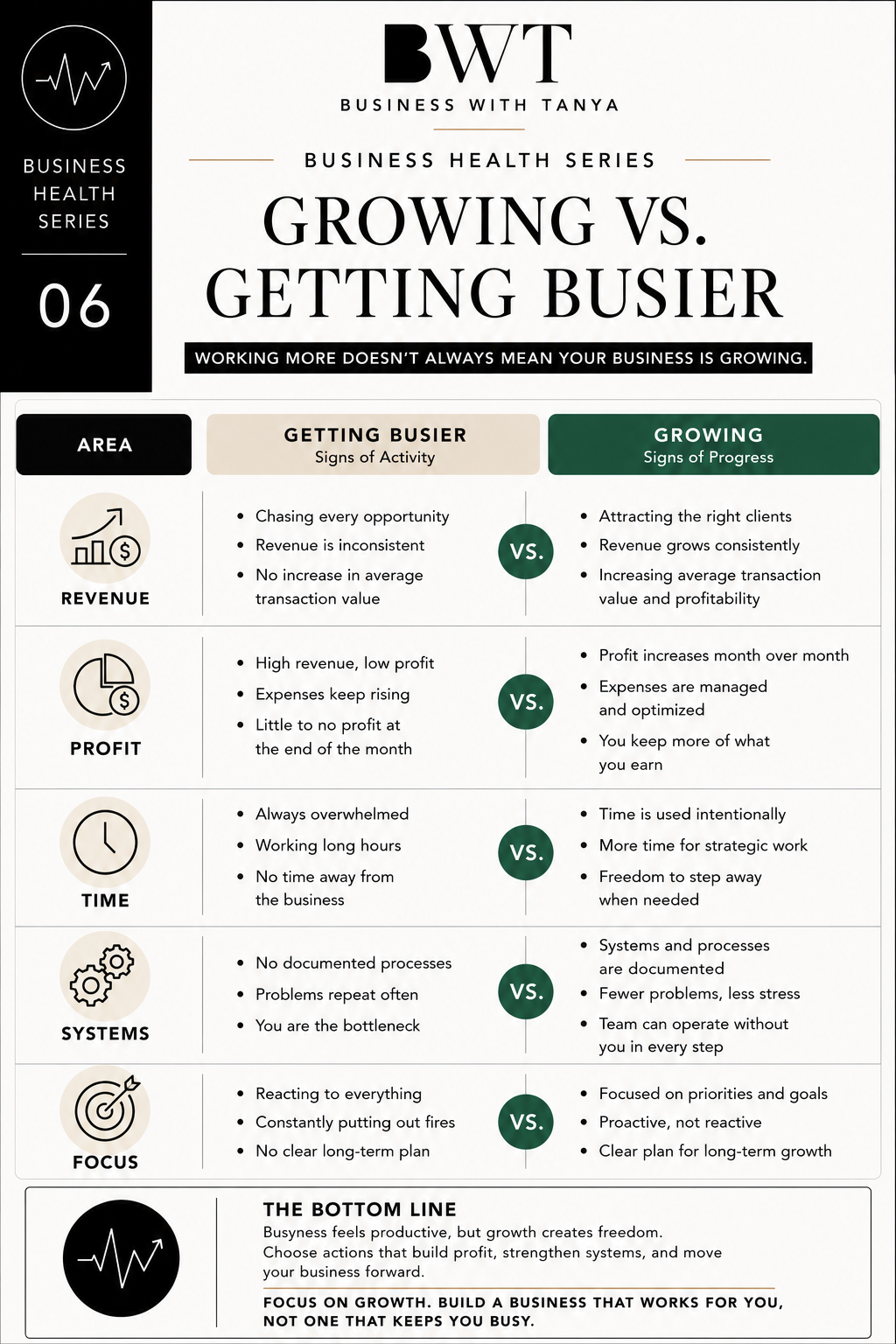
Is Your Business Growing—or Just Getting Busier? Business Health Series | Part 6
More clients.
More sales.
More employees.
More projects.
More hours.
From the outside, all of those things can look like business growth.
But there's an important question every business owner should eventually ask:
Is the business actually growing—or is everyone just getting busier?
Real growth should make your business stronger over time.
If revenue is increasing but profit is shrinking, the team is overwhelmed, systems are breaking, and the owner is working more than ever, the business may be experiencing more activity without creating sustainable growth.
The Direct Answer: What's the Difference Between Growth and Getting Busier?
Getting busier usually means the business is doing more.
Healthy growth means the business is becoming stronger.
That could mean improving:
Revenue
Profitability
Capacity
Cash flow
Systems
Efficiency
Team performance
Owner independence
More work isn't automatically bad.
But the additional work should eventually create something valuable for the business.
Here are five areas to look at.
1. Compare Revenue With Profit
Revenue growth is usually the easiest type of growth to see.
But don't stop there.
If your revenue increased by 25%, what happened to your profit?
If revenue increased while profit stayed the same—or decreased—you need to understand why.
Maybe the business added:
Employees
Contractors
Marketing
Software
Equipment
Office space
Other operating expenses
Some of those investments may be necessary for future growth.
But you still need to understand what they're doing to profitability.
Healthy growth should eventually improve the financial strength of the business, not simply increase the amount of money moving through it.
2. Look at Capacity, Not Just Volume
Imagine your company had 50 clients last year and now has 100.
That's growth in client volume.
But what happened behind the scenes?
If the owner is working twice as many hours, employees are overwhelmed, deadlines are being missed, and customer service is suffering, the business may not have built enough capacity to support that growth.
Ask:
Can our current systems and team handle the amount of business we're bringing in?
The goal isn't to see how much work you can squeeze into the company.
It's to build enough capacity to handle growth well.
3. Understand What Growth Is Costing You
Growth has a cost.
Sometimes that's money.
Sometimes it's time.
Often, it's both.
You may need:
More employees
Additional contractors
Better software
New equipment
More marketing
Professional support
Better systems
Additional space
Those investments can be worthwhile.
But business owners should understand what they're spending to create additional revenue.
For example:
If you spend an additional $75,000 to generate $100,000 in new revenue, that growth looks very different from spending $25,000 to generate the same amount.
The revenue increase is identical.
The financial impact isn't.
4. Check Whether Your Systems Are Keeping Up
Growth has a way of exposing weak systems.
Processes that worked when you had 20 customers may become chaotic when you have 100.
You might start noticing:
Missed follow-ups
Duplicate work
Inconsistent customer experiences
Billing problems
Communication issues
Constant emergencies
Everything needing the owner's approval
These aren't always signs that growth is bad.
They're signs that the business infrastructure needs to catch up.
At some point, the question needs to shift from:
“How can we get more business?”
to:
“How can we handle more business better?”
5. Ask Whether the Business Is Becoming Stronger
This is the bigger question.
Compare your business today with where it was a year ago.
Is it:
More profitable?
More organized?
More financially stable?
Less dependent on you?
Better at serving customers?
Better able to handle growth?
More prepared for unexpected problems?
If revenue has grown but none of those things have improved, it may be time to look at what the growth is actually accomplishing.
What Does This Look Like in Real Life?
Imagine a service business doubles its client base.
Last year:
50 clients
This year:
100 clients
Revenue increases significantly.
On paper, it looks like a great year.
But behind the scenes:
The owner is working nights and weekends.
Employees are overwhelmed.
More mistakes are happening.
Customer response times are getting longer.
Expenses have increased significantly.
And profit barely changed.
The business got bigger.
It definitely got busier.
But did it become better?
Now imagine the company pauses and improves its systems.
It standardizes processes.
It delegates responsibilities.
It reviews pricing.
It improves financial reporting.
It becomes more selective about the clients it accepts.
Maybe the following year it only grows from 100 clients to 115.
But profit improves.
The owner's workload decreases.
The team operates more efficiently.
Cash flow becomes more predictable.
That's a very different kind of growth.
Sustainable Growth Should Create More Than Revenue
A growing business should eventually create more:
Financial stability
Profitability
Capacity
Efficiency
Predictability
Opportunity
Freedom
That doesn't mean growth will always feel easy.
Periods of expansion can be demanding.
But constant chaos shouldn't become the permanent operating model.
If every increase in revenue requires the owner to work significantly harder, the business may need stronger systems before it needs more sales.
The CEO Takeaway
The goal isn't to build the busiest business.
It's to build a stronger one.
Don't measure growth only by:
More customers.
More revenue.
More employees.
More work.
Also measure:
Profit.
Capacity.
Systems.
Financial stability.
Owner independence.
Because the best growth doesn't simply make your business bigger.
It makes your business better.
Continue the Business Health Series
Next: How to Do a Monthly Business Health Check
In the final part of the Business Health Series, we'll bring everything together into a simple monthly review you can use to understand your numbers, identify what needs attention, and decide what your business should do next.
